
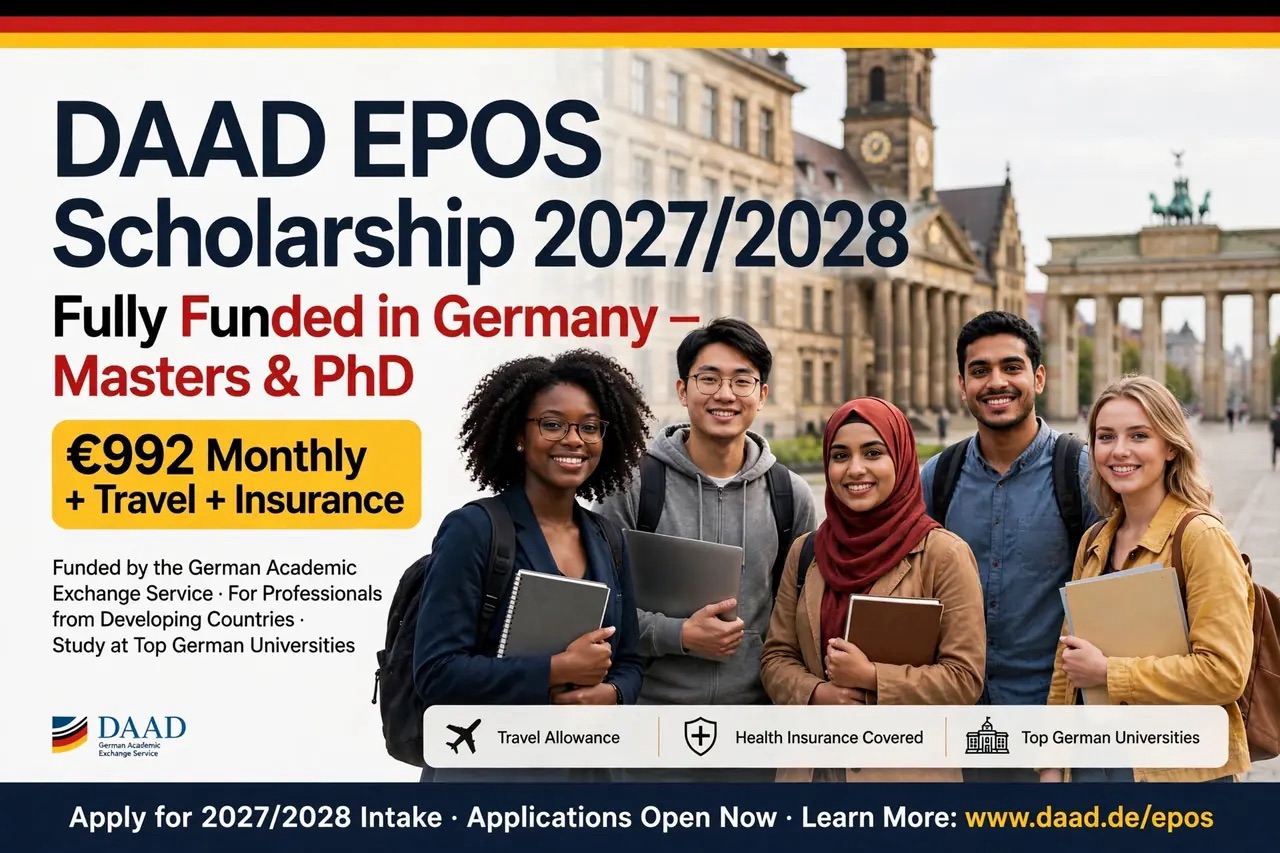
Applications are now open for the DAAD EPOS Scholarship 2027/2028 in Germany – one of the most prestigious fully funded scholarships for professionals from developing countries.
Funded by the German Federal Ministry for Economic Cooperation and Development (BMZ) and administered by the German Academic Exchange Service (DAAD), the Development-Related Postgraduate Courses (EPOS) programme supports talented professionals who wish to pursue a Master’s or PhD degree in development-related fields at top German universities.
This scholarship is specifically designed for working professionals with at least two years of experience who are committed to returning home and contributing to sustainable development.
At a Glance: DAAD EPOS 2027/2028
Feature Details
Funding Body German Academic Exchange Service (DAAD) / BMZ
Study Level Master’s (12-24 months) and PhD (up to 42 months)
Monthly Stipend €992 for Master’s, €1,300-€1,400 for PhD
Coverage Full tuition + stipend + insurance + travel + rent & family support
Eligible Nationality Developing and emerging countries (including Nigeria, India, Kenya, Pakistan, Ghana, Ethiopia, Bangladesh, etc.)
Professional Experience Minimum 2 years required
Application Method Directly to the German university offering the EPOS course
Deadline August – November 2026 (varies by course)
What Does DAAD EPOS Cover? Complete Benefits Package
Unlike many scholarships that only cover tuition, DAAD EPOS is genuinely 100% fully funded:
1. Monthly Stipend:
- Master’s students: €992 per month (around $1,070)
- PhD students: €1,300 per month, increasing to €1,400 from February 2027
- Paid for 12 to 42 months depending on your programme
2. Tuition Fees:
Full waiver – German public universities charge no or very low tuition, and DAAD covers any participation fees.
3. Insurance:
Comprehensive health, accident, and personal liability insurance for your entire stay in Germany.
4. Travel Allowance:
Lump-sum travel grant for your flight to Germany and return flight home after studies (unless already covered by home country).
5. Additional Support (If Applicable):
- Monthly rent subsidy
- Monthly family allowance for accompanying spouse/children (€260 for spouse, €400+ per child)
- One-time study and research allowance of €460
- 6-month German language course in Germany before your studies begin (fully funded)
This makes DAAD EPOS one of the most comprehensive packages in Europe.
Eligible Fields of Study 2027/2028
Only courses listed in the official DAAD EPOS catalogue are eligible. These are all development-related and include over 40 programmes such as:
- Economic Sciences & Business Administration – e.g., MBA in International Trade at HTW Berlin
- Development Cooperation, Political Economics, and Governance
- Engineering, Technology, Sustainable & Renewable Energy
- Agricultural Sciences, Forestry, Environmental Sciences, Water Resources Management
- Urban and Regional Planning, Geography, Architecture
- Public Health, International Health, Medicine – e.g., MSc International Health at Heidelberg University (Deadline: 30 Nov 2026)
- Education Management, Social Sciences, Natural Sciences
Full catalogue: Search “DAAD EPOS courses 2027/2028 list” on DAAD website.
Who Can Apply? Eligibility Criteria
You must meet ALL of these:
- Bachelor’s Degree: Completed 4-year Bachelor’s degree (or 3-year + Master’s) with above-average results – typically top third of your class.
- Professional Experience: At least 2 years of relevant professional experience after your Bachelor’s. Internships and volunteering do NOT count – must be full-time work.
- Graduation Year: Your most recent academic degree should not be older than 6 years at the time of application.
- Residency: You must not have lived in Germany for more than 15 months at the application deadline.
- Development Motivation: You must demonstrate clear motivation linked to development and commitment to return home and contribute to your country’s sustainable development goals.
- Language:
- For English-taught courses: IELTS (6.0+) or TOEFL iBT (80+)
- For German-taught courses: DSH 2 or TestDaF 4, plus 6-month German course funded by DAAD
How to Apply – Step by Step
Step 1: Choose up to 3 Courses
Visit http://daad.de/epos and download the official list of EPOS courses for 2027/2028. You can apply to maximum 3 courses.
Step 2: Check Each Course Deadline
Deadlines are NOT centralized. Each German university sets its own. Most fall between August and November 2026 for studies starting October 2027. Example: Heidelberg International Health = 30 Nov 2026. Some courses close as early as August 2026.
Step 3: Prepare Documents
- DAAD application form (from course website)
- Europass CV
- Motivation letter (max 2 pages) – CRUCIAL: Must link your professional experience to development relevance and why Germany
- Academic transcripts and degree certificates
- Proof of 2 years work experience (employment certificates on company letterhead)
- Language certificates (IELTS/TOEFL)
- Two recommendation letters (one academic, one professional)
- Research proposal (only for PhD applicants)
Step 4: Apply Directly to University
Send your complete application package directly to the selected German university (not to DAAD office in Bonn). The university selection committee shortlists, then DAAD makes final decision.
Why DAAD EPOS is Different from Regular DAAD Scholarships
Many students confuse EPOS with DAAD Study Scholarships. EPOS is:
- For working professionals, not fresh graduates
- Focused on development-related courses only
- Requires 2 years experience
- Offers higher living support plus family allowance
Tips to Win DAAD EPOS 2027
- Your work experience must be development-relevant. If you apply for Public Health, show you worked in health sector.
- Motivation letter = 50% of decision. Explain: What development problem does your country face? How will this German degree help you solve it after return?
- Apply to 3 courses to increase chances, but tailor each motivation letter.
- Get strong professional recommendation from your employer stating your development impact.
FAQ
Q: Can I apply without 2 years experience?
No, this is mandatory for EPOS. If you are a fresh graduate, apply for DAAD Study Scholarships (STEM) instead – deadline 24 Sept 2026.
Q: Does DAAD EPOS require IELTS?
Yes for English-taught courses. Some German universities accept English proficiency letter if your Bachelor’s was in English, but IELTS is safer.
Q: Is family allowed?
Yes, DAAD provides family allowance and supports family reunion visa.
here are resources to help you prepare more for this scholarship explore our guides below.
Documents You Should Always Have Ready for Scholarships, Jobs, Grants and Fellowships
Complete Scholarship Application Checklist: Everything You Need Before You Apply
need a professional website for your business & portfolio?
Get Your Professional Website Today — Domain + Hosting + Design
Leave a Reply